

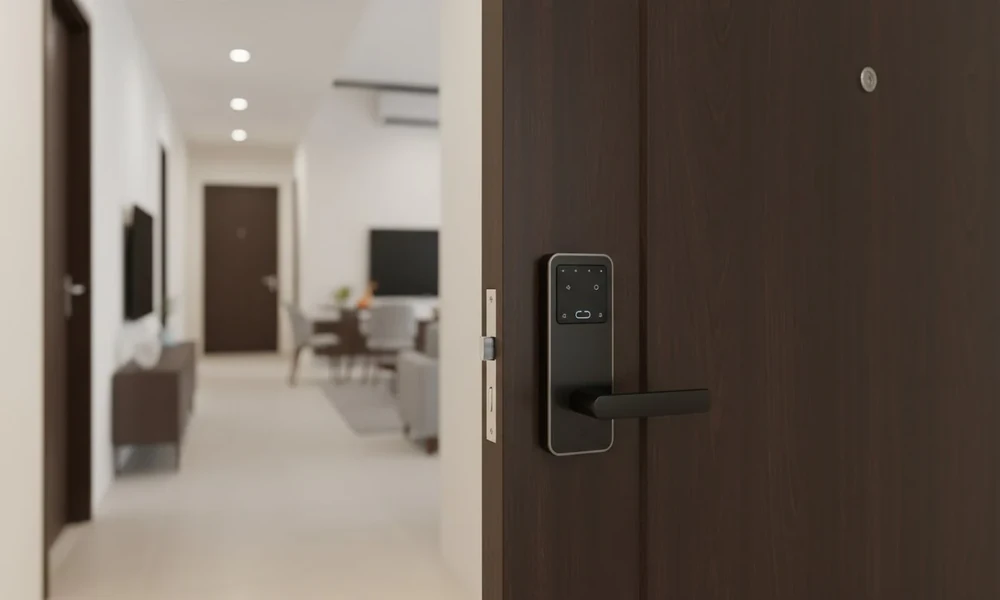
Not every door that looks the part is one. The distinguishing factor is certification: an SCDF approved fire rated door Singapore contractors install has been tested as a complete assembly and listed against a recognised standard, and that listing is what an inspector checks, not the door’s weight or the material it appears to be made from.
This trips up a fair number of building owners who assume a solid, heavy-looking door will satisfy fire code requirements on its own. It will not, unless it carries the paperwork to prove what it was actually tested to do.
How a Fire Door Gets SCDF Approval
Fire door approval in Singapore runs through testing against standards such as SS 332, or recognised international equivalents like BS 476 Part 22 or EN 1634-1, carried out by an accredited testing laboratory. The test exposes the complete door assembly, door leaf, frame, hinges, seals, and any glazing, to controlled fire conditions for a set duration, and the assembly only earns its rating if it holds its integrity, and where required its insulation, for that full period.
The manufacturer then registers the exact configuration that was tested, and any door installed on a project has to match that registration, down to the leaf thickness, frame section, and hardware specification. A door that looks structurally identical but uses a different hinge model to the one tested is not automatically covered by the same certificate.
Understanding Fire Rating Classes
Fire doors in Singapore are most commonly specified at half-hour and one-hour ratings, meaning the duration the assembly maintains its integrity under test conditions. Riser doors, service cupboards, and some internal compartment walls typically call for half-hour rated doors, while doors to protected staircases, lift lobbies, and units bordering higher-risk occupancies commonly require the one-hour rating. An SCDF approved fire rated door carries a label stating which of these classes it belongs to.
The applicable rating for a given location is set by the fire safety design for the building as a whole, not chosen independently door by door, so the correct starting point for any project is the approved fire safety certificate drawings rather than a general assumption about what a particular room needs.
Where Approved Doors Are Required
SCDF’s Fire Code sets out where rated doors are mandatory: enclosed staircases, corridors serving as a means of escape, lift lobbies in certain building types, kitchens in food and beverage premises, electrical and mechanical riser rooms, and units directly adjoining these spaces. Landed residential properties generally fall outside these requirements unless a specific use, such as a home business involving flammable materials, brings them into scope. SCDF approved fire doors are also required at any opening the base building design has already identified as a compartment boundary.
Commercial tenants fitting out a unit within an existing building often discover these requirements only when their fit-out submission goes through review, since the base building’s fire safety design already assumes rated doors will be installed at these locations by the tenant.
Keeping the Approval Valid After Installation
Approval does not stay valid automatically. It depends on the door remaining in the condition it was tested in: intumescent seals intact, self-closing device functional and correctly adjusted, certification label visible and legible, and no unauthorised hardware substitutions such as an added lock or a viewing panel cut into the leaf after installation.
Repainting is one of the more common ways an approval gets quietly compromised, since paint applied over the certification label, or built up thickly enough to interfere with the intumescent seal’s expansion, can affect how the assembly performs even though the door looks unchanged. Periodic checks, ideally aligned with a building’s routine fire safety inspection, catch these issues before they turn into findings during an SCDF audit.
For MCSTs, building owners, and tenants preparing a fire safety submission, sourcing an SCDF approved fire rated door Singapore regulations require, with documentation that matches what is actually installed, is the difference between a submission that clears on the first review and one that comes back with queries. Boon Woh Woodwork Co supplies and installs doors against their registered certification, with the paperwork to match, for exactly this reason.