

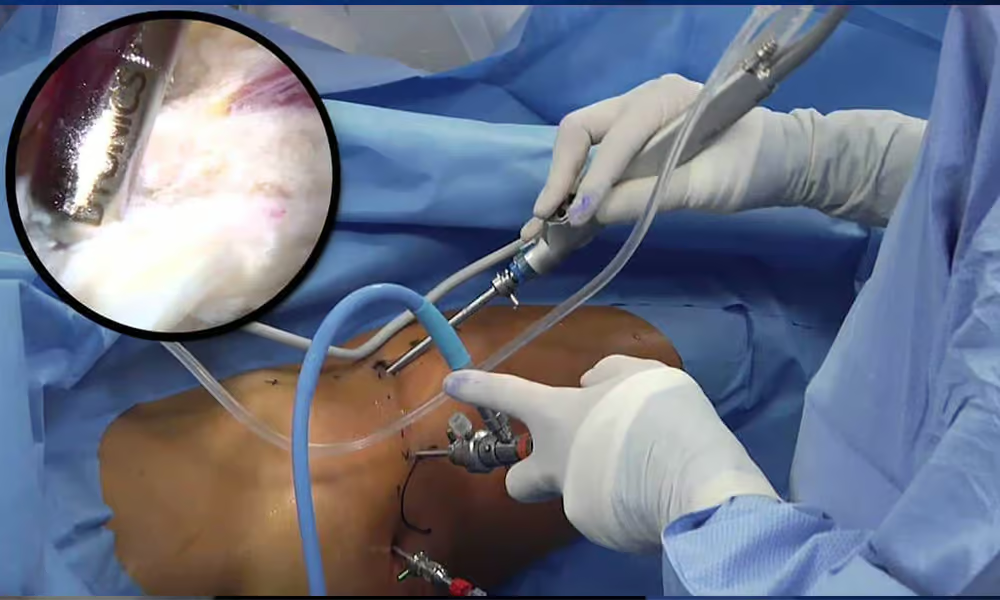
AMT endoscopy raises a question worth examining from first principles: why does the development of minimally invasive visualisation technology follow such a consistent pattern across medical history, advancing in capability wherever clinical need and engineering innovation converge? The answer, as with many questions about how medical technologies evolve, lies in the relationship between what clinicians need to see, what patients can tolerate, and what precision manufacturing makes possible. Advanced minimally invasive therapeutic endoscopy has followed exactly that pattern, and understanding where it stands today requires understanding the forces that shaped it.
What AMT Endoscopy Actually Is
Advanced minimally invasive therapeutic endoscopy represents the convergence of diagnostic imaging, precision instrumentation, and targeted intervention within a single procedural framework. Where earlier endoscopic technology was primarily observational, modern AMT platforms integrate high-definition optical systems, articulating instrument channels, and therapeutic delivery mechanisms that allow clinicians to diagnose and treat conditions in a single procedure without the recovery burden of open surgery.
The clinical logic is straightforward. An endoscope that can visualise a lesion in the gastrointestinal tract, deliver a biopsy tool through its working channel, and apply therapeutic energy to the target tissue in the same session reduces patient exposure, shortens hospital stays, and lowers the procedural cost per episode of care. That combination of benefits has driven adoption across specialties and created sustained demand for instruments of increasing capability and refinement.
The Technologies That Define Modern AMT Systems
The engineering that underpins AMT endoscopic systems draws from several disciplines simultaneously, and the interaction between them is where the most significant advances have occurred.
Optical Systems
Optical systems have followed the trajectory that Diamond’s comparative method would predict: steady improvement driven by the convergence of sensor technology, illumination engineering, and image processing. High-definition chip-on-tip cameras now transmit images at resolutions that allow mucosal vascular patterns to be assessed in real time. Narrow band imaging and chromoendoscopy techniques enhance contrast between normal and abnormal tissue without requiring exogenous dyes, giving clinicians information that standard white light cannot provide.
Instrument Channel Design
Instrument channel design has evolved in parallel. The working channels through which biopsy forceps, injection needles, clip applicators, and energy delivery devices are passed have been engineered to accommodate increasingly sophisticated tools while maintaining the flexibility required to navigate tortuous anatomy. Dual-channel scopes allow simultaneous use of multiple instruments, expanding what is achievable in a single therapeutic session.
Articulation And Controllability
Articulation and controllability represent a third dimension of development. Single-operator balloon-assisted enteroscopy, cap-assisted techniques, and robotic-assist platforms have each extended the anatomical reach of advanced therapeutic endoscopy, allowing access to regions of the gastrointestinal tract that earlier instruments could not reliably enter.
Clinical Applications Across Specialties
The applications of amt endoscopy technology span a range that reflects the breadth of conditions addressable through luminal access.
Gastrointestinal oncology
Endoscopic mucosal resection and endoscopic submucosal dissection allow the removal of early-stage mucosal and submucosal lesions without surgical resection, preserving organ function and reducing recovery time substantially
Biliary and pancreatic intervention
Endoscopic retrograde cholangiopancreatography platforms equipped with therapeutic accessories enable stone removal, stent placement, and tissue sampling in the biliary tree and pancreatic duct
Haemostasis and bleeding management
Clip application, injection therapy, and thermal coagulation delivered through the endoscope manage acute gastrointestinal bleeding with a level of precision and speed that surgery cannot match in the acute setting
Stricture and obstruction management
Balloon dilation, stent deployment, and stricture incision techniques address benign and malignant obstructions across the oesophagus, stomach, small bowel, and colon
Diagnostic tissue acquisition
Advanced biopsy platforms, including endoscopic ultrasound-guided fine needle aspiration and biopsy, provide tissue samples from structures adjacent to the gastrointestinal wall that surface inspection alone cannot reach
Singapore’s Position in AMT Endoscopy
Singapore’s healthcare infrastructure has made it a significant centre for advanced endoscopic procedures in Southeast Asia. Its tertiary institutions perform high volumes of complex therapeutic endoscopy, supported by clinical teams trained at international centres and equipped with current-generation AMT platforms. The country’s position as a regional medical hub means that patients from across the Asia Pacific region access advanced endoscopic procedures in Singapore that may not yet be widely available in their home health systems.
Beyond the clinical setting, Singapore’s precision manufacturing sector contributes to the supply chains that produce the instruments and components used in AMT endoscopic procedures. Cleanroom-manufactured single-use accessories, precision-formed metal components, and polymer device parts produced to medical grade specifications support the procedural volumes that tertiary endoscopy programmes generate. The intersection of clinical capability and manufacturing excellence reflects the same logic that has driven Singapore’s broader positioning in life sciences.
Why the Development Trajectory Continues
Technologies that solve real clinical problems do not reach a stable endpoint. They continue developing because the problems they address are not static. Gastrointestinal cancer rates are rising in many populations. The preference for minimally invasive intervention over open surgery is strengthening as evidence accumulates. Ageing populations in Asia, Europe, and North America are generating more procedural demand, not less.
Each of those pressures acts on the development of amt endoscopy in the same way that environmental pressures act on biological adaptation: by selecting for capabilities that address the challenge most effectively. The platforms that integrate superior imaging, broader therapeutic reach, and greater operator control will continue to displace those that offer less. That is not prediction. It is pattern recognition applied to a technology whose development logic is already clearly established. For clinicians, health systems, and manufacturers engaged with AMT endoscopy, that trajectory rewards careful and continued attention.